Without Panic Maths · Number 33
Comparing and Ordering Fractions
To compare fractions fairly, the wholes must be the same size. Then use the quickest tool: same denominators, same numerators, a benchmark like 1/2, a number line, or a common denominator.
- Mini-lessons
- 9
- Questions
- 132
- Student Pack
- 95 pages
- Suggested year
- Year 8
What you get
- Student Pack (PDF, 95 pages)
- Teacher Pack (PDF) with every answer and reteach cards
- Print as many copies as you need for your own pupils
Save with a bundle
- Fractions9 packs ·
£31.50£28 - Number, Year 819 packs ·
£66.50£59 - Number: complete strand54 packs ·
£182£161
What this pack does
What pupils learn
To compare fractions fairly, the wholes must be the same size. Then use the quickest tool: same denominators, same numerators, a benchmark like 1/2, a number line, or a common denominator. Always say which is bigger and why.
The mini-lessons
- Comparing fractions means comparing amounts
- Same denominator: compare the numerators
- Same numerator: compare the denominators
- Comparing with one half
- Comparing with zero and one whole
- Comparing fractions on number lines
- The formal common- denominator method
- Ordering several fractions
- Comparing mixed numbers and Mistake Detective
Inside every pack
What each part of the page is for
Confidence check
Pupils tick how a topic feels before they start, and again at the end. There are no marks, so it's an honest picture of where they are.
Short mini-lessons
Each topic is split into small steps. Every mini-lesson opens with one big idea and a short, plain-English explanation.
Visuals for every idea
Diagrams such as a formula 'rule machine' or a place-value picture show the maths, so pupils can see it as well as read it.
Worked examples
Every method is modelled step by step before pupils try it, with each stage labelled so they can follow it on their own.
Scaffolded practice
Questions start with prompts (what do you need to find, follow the example, check it makes sense) and gradually ask for more independence.
Spot the trap
Common mistakes are named before pupils make them, and Mistake Detective questions ask them to find and fix errors.
Pause and think
Short 'explain it in your own words' prompts check that pupils understand why the maths works, not just how.
Teacher Pack with answers
Every pack comes with a Teacher Pack: all the answers, plus reteach cards saying what to watch for, what to say, and what to try if a pupil is still stuck.
More number packs
You might also like
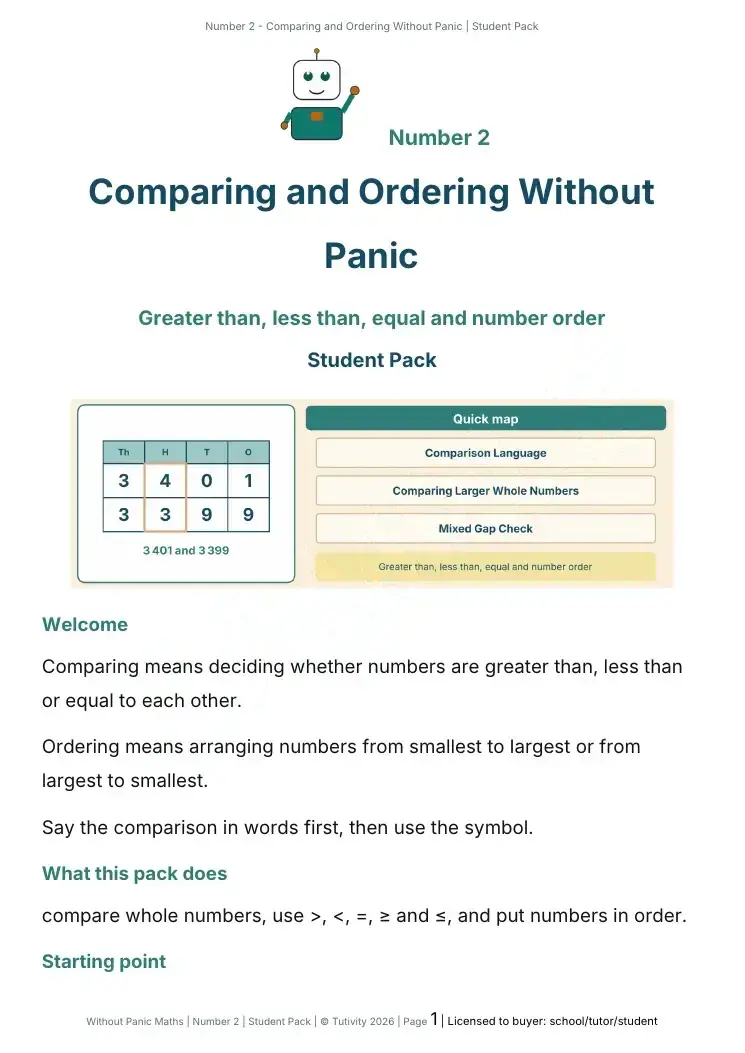
Comparing and Ordering
Comparing means deciding whether numbers are greater than, less than or equal to each other. Ordering means arranging numbers from smallest to largest or from largest to smallest.